Dear colleagues,
As I complete my third week serving you as UConn’s interim Vice President for Research, Innovation, and Entrepreneurship, I am reflecting with gratitude on this opportunity. I have spent over 25 years in higher education as a student, faculty member, active investigator, department head, and the past two years in the OVPR as Associate Vice President. It is undeniable that we are facing unique challenges right now in higher education and research. However, my professional and personal experience have taught me that hard times draw out unexpected stores of resilience. As a researcher, my career has been dedicated to working with athletes – strong and capable women and men – helping them overcome their most trying physical and mental challenges. In my personal life, I advocate daily for children with a rare disease. These experiences have empowered my resilience and fortitude, which I now bring to this role. No matter how challenging the circumstances may be, our focus in the OVPR will be on the "how" and not the "what if" – how do we maintain our status as a top tier research institution; how do we advance our goal toward AAU membership; and how do we better serve our faculty, staff, students, the state, and the public mission.
In that spirit, I’d like to share a few thoughts on some things that we can do that will prepare us to take on what might seem impossible.
Recognize that research is a team sport. Joining the OVPR in 2023 gave me a fresh opportunity to grasp the breadth of the amazing work done by all of us at UConn and UConn Health. We make real impacts on the lives of our students, our communities, our society, and each other not only through research and scholarship, but also through teaching, clinical care, service, creative arts, and engagement. These are the pillars of the diversified work of an R1 university, like UConn. These massive engagements depend on each unit and each member performing their responsibilities well and often above and beyond. The success of UConn Research depends on you -- no matter if you primarily teach, advise, coordinate programs, help the university purchase materials, provide clinical care, take care of our facilities and campus, or directly participate in research. With that in mind, I hope every one of us takes the same pride in the research we discover as we take in the championships UConn wins. I know I do.
Assume goodwill. In 2019, I sat in a conference room as Head of the Department of Kinesiology while Indrajeet Chaubey was interviewing to become the dean of CAHNR. Indrajeet was asked what his guiding value was as a leader. He shared that a mentor of his taught him the principle of “assume goodwill.” He adopted it for himself, and I have done the same.
If we are going to weather this storm, it is imperative that we work together and “row the boat” in the direction to propel UConn forward, often against the tide. Everyone is doing their best to help us all succeed. The approach of “assume goodwill” cements this shared mission. None of us are perfect, and we can overcome most obstacles when we are willing to assume goodwill first and then look for solutions together.
Commit to open communication. I know we here in the OVPR can communicate more, and we are committed to doing so. We will use this format to distribute biweekly updates to you all to share answers to questions, disseminate resources, provide timely updates, and celebrate our community wins.
I believe and have shared frequently with others that no one person at the University has all the perfect answers, especially now. We are fortunate to be at a university with very bright and creative people. I invite you to share your ideas that can help us solve problems.
We created a brief survey to identify what topics and methods of communication are most beneficial. We are grateful for your participation. Moving forward, specific questions and ideas can be communicated using this short webform.
|
|
|
Thank you for all you do,
|
|
|
|
Lindsay J. DiStefano, PhD, ATC, FNATA
Interim Vice President for Research, Innovation, and Entrepreneurship
UConn | UConn Health
Professor
Department of Kinesiology
Department of Orthopaedic Surgery
Department of Public Health Sciences
|
|
|
|
Q&A: Your Questions, Answered
|
*This week’s Q&A is longer than usual as I want to address important questions about IDCs and the EMERGE program. If you have a question for the OVPR, please submit them here.
What are IDCs?
Indirect costs (IDCs) are reimbursements to the university for research expenses already paid. They are not sources of revenue.
What is the history of how IDCs have been distributed?
The university operates on a July 1 – June 30 fiscal year. FY25 was July 1, 2024 – June 30, 2025.
IDC distributions have evolved in step with institutional needs:
|
Storrs and regional campuses:
Prior to 2004, UConn distributed IDC reimbursements in December following each fiscal year to the school-college / department / PI at the rate of 10/5/0 (school-college / department / PI).
In FY 2004, UConn began distributing a percentage to PIs as well, at a rate of 10/5/5 with a 2-year limit on PI spending.
In FY 2011, UConn increased the distribution of IDC reimbursements to the FY24 rate of 10% / 10% / 10% with a 2-year limit for spending those funds.
In FY 2012, the 2-year limit for spending was removed, allowing balances to accumulate.
UConn Health:
Prior to FY 2015, 8% of IDC reimbursements were distributed to department / division chairs or center directors and 2% to deans.
In FY 2016, the distribution changed to 5% to PIs, 7% to department / division chairs or center directors, and 4% to deans.
In FY 2019, the distribution changed to 7% to PIs, 7% to chairs, and 7% to directors/deans.
UConn Health IDC reimbursements have been distributed on a real-time basis.
|
What has changed with the distribution of IDCs and what is the plan for the future?
In June 2025, the university made several decisions to help mitigate the university fiscal deficit due to an ineffective university budget model and declining state support, and to help the university manage the uncertainty around the federal research funding environment. Two of these decisions are related to IDC reimbursement distribution and were communicated with the university on June 23, 2025:
FY25 Storrs IDC reimbursements, scheduled for distribution in December 2025, are paused. The decision to distribute these funds will be assessed in early 2026 based on the federal funding climate and other budget factors.
Starting after July 1, 2025, PIs at UConn and UConn Health will receive a 5% real-time allocation of FY26 IDC recoveries. No FY26 IDC recovery distributions will be made to schools/colleges, centers/institutes, and departments. IDC recoveries will be used to maintain critical research operations and infrastructure, and towards emergency funding through the EMERGE program.
How much research funding has UConn lost due to federal terminations?
As of 10/15/25, the university has lost $41M due to research grant terminations and unexpected non-renewals. In addition, new research awards were down $54M in FY25 compared to FY24 (UConn was on pace for FY25 awards to exceed FY24 new award levels in November 2024).
We are projecting an additional $34M annual loss across all campuses if the federal government limits IDC reimbursement rates to 15%. (Again, these are reimbursements of costs already paid)]
What is the EMERGE program?
The EMERGE program provides short-term support to address situations out of an investigator’s control related to the federal research environment. Priority is given to funding the university’s obligated costs (e.g., salaries and graduate student support according to contracts), to provide “gap” coverage to keep labs/operations viable at minimal levels to allow time for investigators to pursue other sources of funding, and to support graduate students in completing their degrees. EMERGE funding is distributed on a short-term basis with clear understanding and procedures in place to reimburse university funds if cancelled awards / programs are reinstated or new sources of funding are acquired.
How many EMERGE awards have been distributed and for what reasons?
As of 10/20/25, 12 EMERGE awards have been made, with total commitment of $1.6M, including PI, Department, Center/Institute, School/College, and OVPR contributions (OVPR commitment has been $932K),for the following reasons:
|
- Stop work order at another university
- NIH Cancellation
- EPA Cancellation
- NIH Cancellation
- USAID Cancellation
- USAID program terminated, NIFA program frozen
- Alexion cancellation
- DOE award delay, Hatch award Executive Order motivated decline
- SNAP-Ed program cancelled
- NIH award indefinitely on hold because of funding freeze at another university
- NSF award cancelled
- NIH award cancelled, program area no longer fundable
|
Who was involved with the creation of the EMERGE program?
The EMERGE program was developed in conjunction with the OVPR, the university research deans, Center / Institute directors, and the ad hoc faculty / staff task-forces launched in November 2024 to help manage the federal research environment.
Who approves EMERGE applications?
All EMERGE applications must receive approval from school / college and department leadership, the EMERGE committee (comprised of university research deans and Center / Institute directors), and OVPR leadership.
Where has funding for EMERGE awards come from?
EMERGE projects are supported by contributions by PIs/Co-PIs, Departments, Centers/Institutes, Schools/Colleges, and the OVPR. At this point in time, OVPR contributions have been drawn exclusively from the OVPR’s internal seed grant budget.
|
|
|
|
|
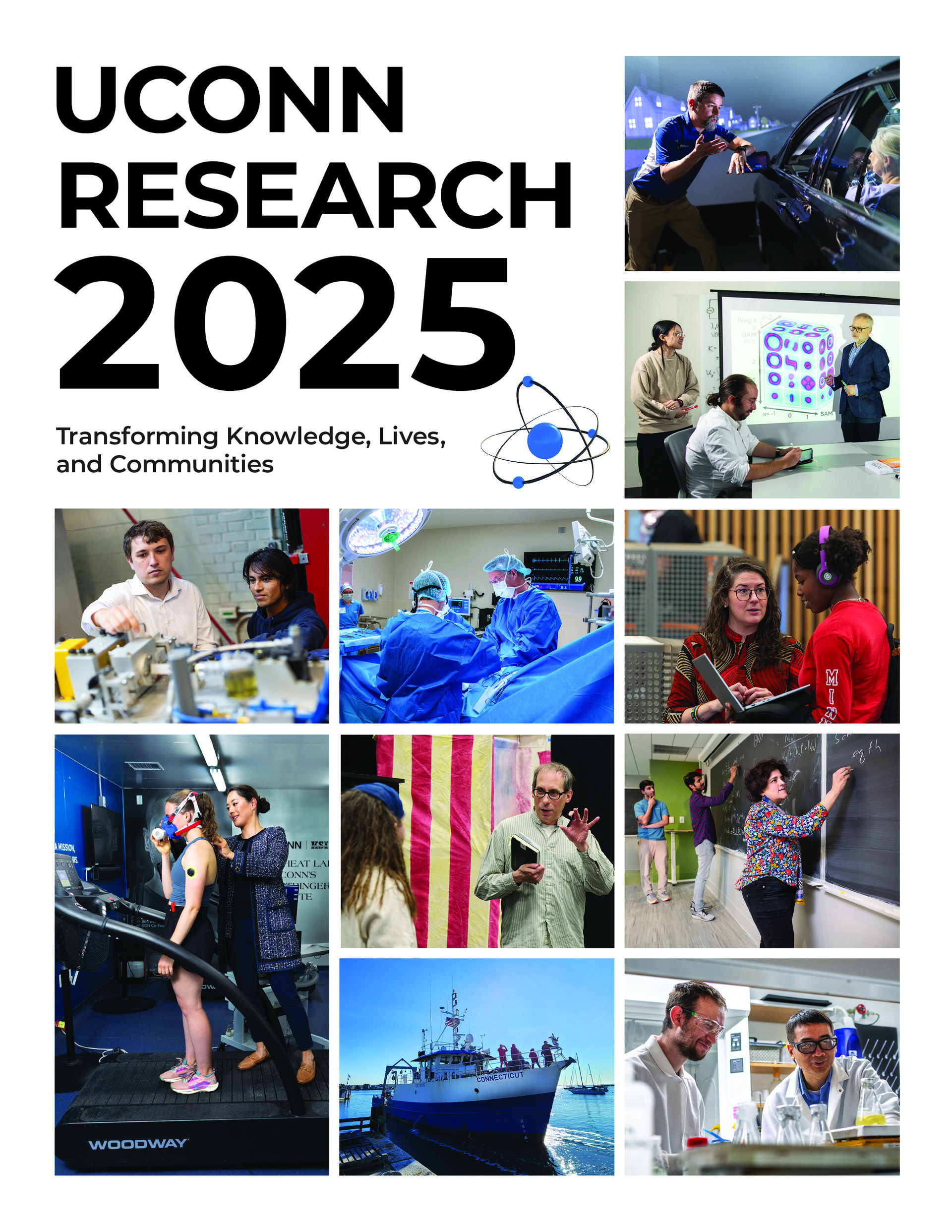
UConn Research's "2025 Year in Review" spotlights the innovation, community involvement, and significant contributions of our research and development endeavors. Covering areas from quantum science and AI to national security and health & life sciences, the report illustrates how UConn fosters innovation, bolsters economic growth across Connecticut, and addresses our nation’s urgent priorities.
|
|
|
|
|
Additionally, the OVPR is happy to share our final FY25 research funding numbers that demonstrate your outstanding effort and commitment to UConn’s pursuit of positive impacting society through research and innovation.
|
|
|
ICYMI: Recent Announcements
|
|
|
The federal government shutdown enters its fourth week. As of
today, UConn can still draw funds from federal agencies. Please
see SPS guidelines regarding shutdown information.
The Department of Energy (DOE) released a list of grants to be
terminated. UConn has received five official terminations. The state recently joined a multistate lawsuit. The Democrats in the House of Representatives submitted a letter contesting this partisan action.
Together with Governmental Relations, I met with staff from our
federal delegation (Senators Murphy and Blumenthal,
Representatives DeLauro, Hayes, Hines, Larson, Courtney) last
week to discuss recent developments federally and ensure they
understand UConn’s current situation with federal funding. We
remain in close contact.
*Reminder – please reach out to and/or copy Governmental
Relations if you have an opportunity or need to meet with our federal delegation or staff.
|
|
|
Telling Your Research Story Virtual Workshop (Nov. 5, 10 AM - 12 PM) will provide you with hands-on guidance for telling an impactful and concise story about your research. The workshop will provide best practices and a template for communicating research to the public and stakeholders and time to workshop your own story.
|
|
|
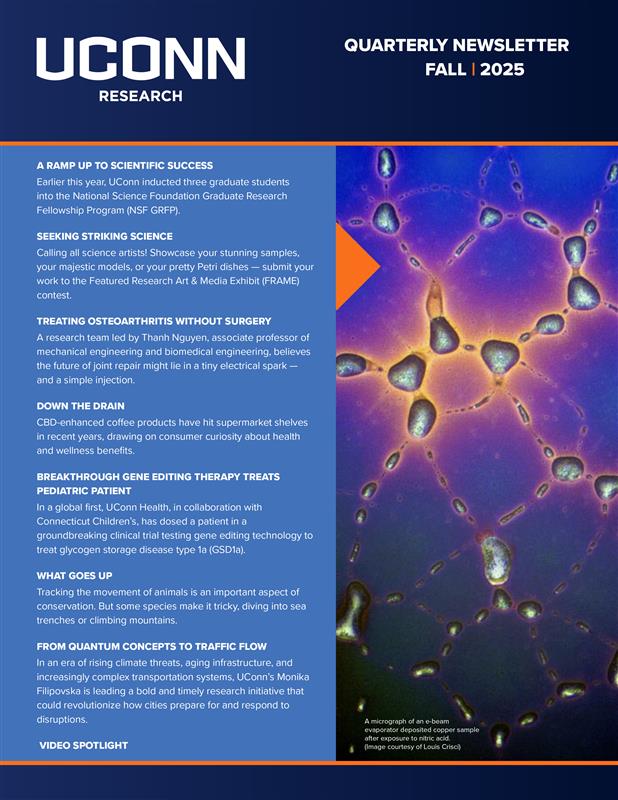
Please complete a brief survey to help guide our communications efforts.
|
|
|
UNIVERSITY OF CONNECTICUT
OFFICE OF THE VICE PRESIDENT FOR RESEARCH
|
Whetten Graduate Center
438 Whitney Road Extension, Unit 1006
Storrs, Connecticut 06269-1086
research.uconn.edu
|
|
|
|
|
|